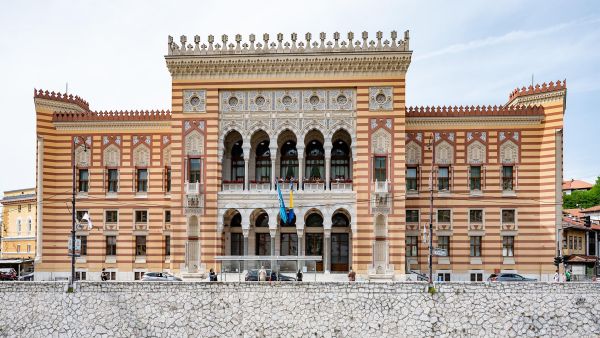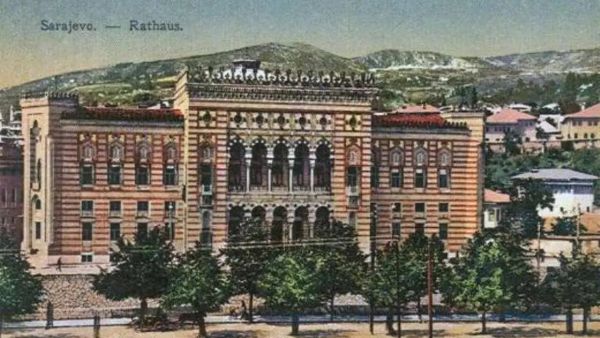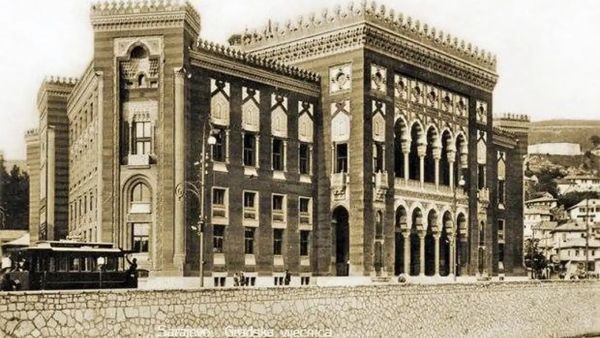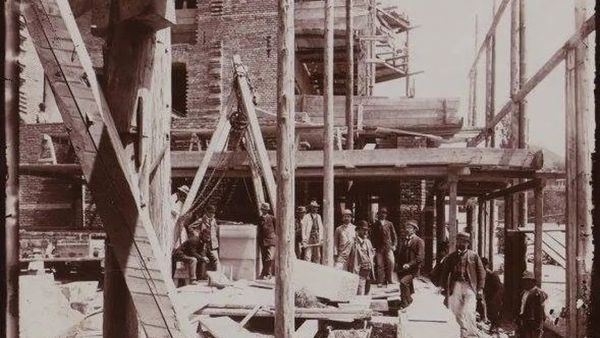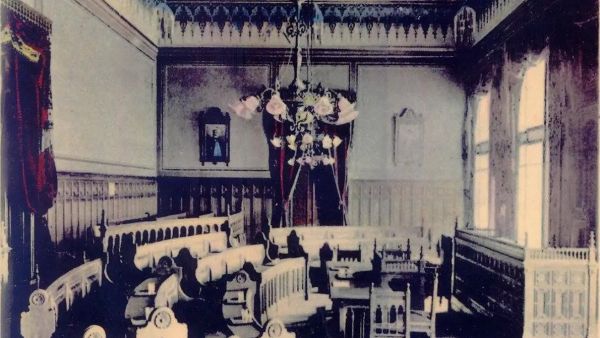
The City Hall was officially opened in 1896, after a construction process marked by true drama.
Pseudo-Moorish Style
The original design was created by Alexander Wittek, who envisioned the new seat of the city administration in a pseudo-Moorish style, an architectural language that fused the rich elements of Islamic art from Spain and North Africa with European construction standards.
Due to disagreements with the authorities and serious health problems, Wittek withdrew from the project. The work was then taken over by Ćiril Iveković, who significantly modified Wittek’s plans, adding grandeur to the final façade and its decorative details. Interior design was ultimately supervised by painter Franz Mühlenfeld. This ensemble of masters, each leaving their own signature, turned Vijećnica into a masterpiece that perfectly reflects Sarajevo’s cosmopolitan spirit.
When you step inside, you immediately understand why Vijećnica is seen as a global symbol of the meeting of civilizations. The entire space is conceived as a visual dialogue between the Orient and the Occident.
Entering the Aula takes your breath away. The central hexagonal hall stretches over two floors, surrounded by arches and columns adorned with geometric and floral motifs. But the true dominant feature is the spectacular dome – a stained-glass roof and mosaic that filter the light and paint the interior in shimmering colours. The intensity of the hues, the mosaics, and the grand stone staircase, crafted to the highest standards, make this one of the most beautiful buildings in the Balkans. It stands as physical proof that diverse cultural influences can coexist in perfect harmony and beauty.
Vijećnica has a rich and layered history. It served as the City Administration, the District Court, and after the Second World War, it became the National and University Library of Bosnia and Herzegovina. Its shelves once held priceless treasures – more than two million books, documents, and manuscripts: the very essence of the country’s collective memory.
Tragically, the fate of Vijećnica is also tied to the darkest chapter of Sarajevo’s past. On the night of 25–26 August 1992, at the very beginning of the siege, the building was struck by incendiary shells and burned to the ground. Nearly 90% of the library’s collection was lost.
A Search Through Archives
But Vijećnica, much like Sarajevo itself, survived. The reconstruction lasted almost two decades. Restorers and craftsmen worked meticulously to recreate every detail, from mosaics to frescoes, using original documentation they searched for across archives throughout the former Austro-Hungarian territories.
It was officially reopened on 9 May 2014, on Europe Day and Victory Day over Fascism, a triumphant reminder that the culture, history, and spirit of a city cannot be destroyed.
Today, Vijećnica is a multifunctional space: home to the city authorities, a venue for official ceremonies, and above all, a museum and exhibition hall.
Vijećnica is a story of resilience, beauty, and the meeting of worlds – a perfect starting point for exploring Sarajevo.
You can visit it daily from 9 AM to 5 PM. Entry costs 5 BAM for children, students, pensioners, and people with disabilities, and 10 BAM for adults.